
If you’ve ever stood in your backyard with a hose in hand, wondering whether you’re helping your grass or slowly drowning it, you’re not alone. Edmonton homeowners deal with a strange mix of conditions every summer hot, dry stretches followed by sudden cool snaps, the odd hailstorm, and a growing season that’s shorter than almost anywhere else in the country. That combination makes watering one of the most confusing parts of lawn care here, and it’s the question our crews at Season Edge get asked more than almost any other.
The short answer: most Edmonton lawns do best with deep watering 2 to 3 times per week, rather than a quick sprinkle every day. But the real answer depends on your grass type, your soil, the season, and even which part of your yard you’re standing in. Let’s break it down properly.
Why Edmonton Lawns Play by Different Rules
Edmonton sits in a part of the country where lawns are almost entirely cool-season grasses think Kentucky Bluegrass, Fine Fescue, and Perennial Ryegrass. These grow hard in June and July, slow down when the August heat hits, and can look tired and brown by late summer even when they’re perfectly healthy. That browning isn’t your lawn dying; it’s dormancy, a survival response to heat and dryness, not a sign you need to reach for the hose more often.
At the same time, Edmonton’s annual rainfall is modest, often under 400 mm for the year, so your sprinkler is doing real work that nature isn’t fully covering. The trick is giving your lawn just enough water, at the right times, without falling into the most common trap homeowners fall into here: watering a little bit, every single day.
The Golden Rule: Deep and Infrequent Beats Daily and Shallow
One of our technicians tells a story about a client in Riverbend who ran her sprinklers for fifteen minutes every evening, all summer long, convinced she was doing right by her lawn. Her grass still looked patchy and stressed by July. The problem wasn’t a lack of water — it was that the water never made it past the top inch of soil. Her roots had no reason to grow deep, so they stayed shallow and fragile, and the first hot week left the whole lawn gasping.
That’s the core issue with daily light watering: it trains your grass to be lazy. Roots stay near the surface because that’s where the moisture always is, and shallow roots can’t survive Edmonton’s dry spells or its blazing August afternoons.
Instead, aim for:
- 2 to 3 watering sessions per week
- About 1 to 1.5 inches (25–38 mm) of water per week total, including rainfall
- One deep soak per session rather than several short bursts
This pushes roots downward, chasing the moisture deeper into the soil, which builds a lawn that can handle heat, foot traffic, and dry stretches without falling apart.
A Simple Seasonal Breakdown
Watering isn’t a “set it and forget it” job what your lawn needs in May is very different from what it needs in August.
Spring (May–early June): This is peak growth season for cool-season grass in Edmonton. Rainfall is often enough on its own, so you may only need to water once or twice a week, and sometimes not at all during a wet stretch.
Summer (July–August): This is where most of the confusion happens. Water deeply twice a week, ideally before 9 a.m., delivering around 25 mm per session. If your lawn goes tan and dormant during a heat wave, resist the urge to overcompensate a deep soak once the temperature breaks is more effective than panic-watering every evening.
Fall (September–October): Growth picks back up as temperatures cool, and root development is at its most active. Keep watering deeply through this period, since a well-hydrated lawn heading into freeze-up survives winter far better than one that goes into dormancy dry.
Winter: Once the ground freezes, watering stops entirely. There’s nothing to gain and plenty of risk in trying to water frozen soil.
Timing Matters as Much as Frequency
Water early in the morning, ideally before 9 a.m. Edmonton mornings tend to be cool with light dew, which means less water is lost to evaporation and more actually reaches the roots. Evening watering might feel convenient after a long day, but it leaves grass damp overnight, which is exactly the kind of condition that invites fungal problems like snow mold going into fall.
Signs Your Watering Schedule Needs Adjusting
Your lawn is usually pretty good at telling you what it needs, if you know what to look for:
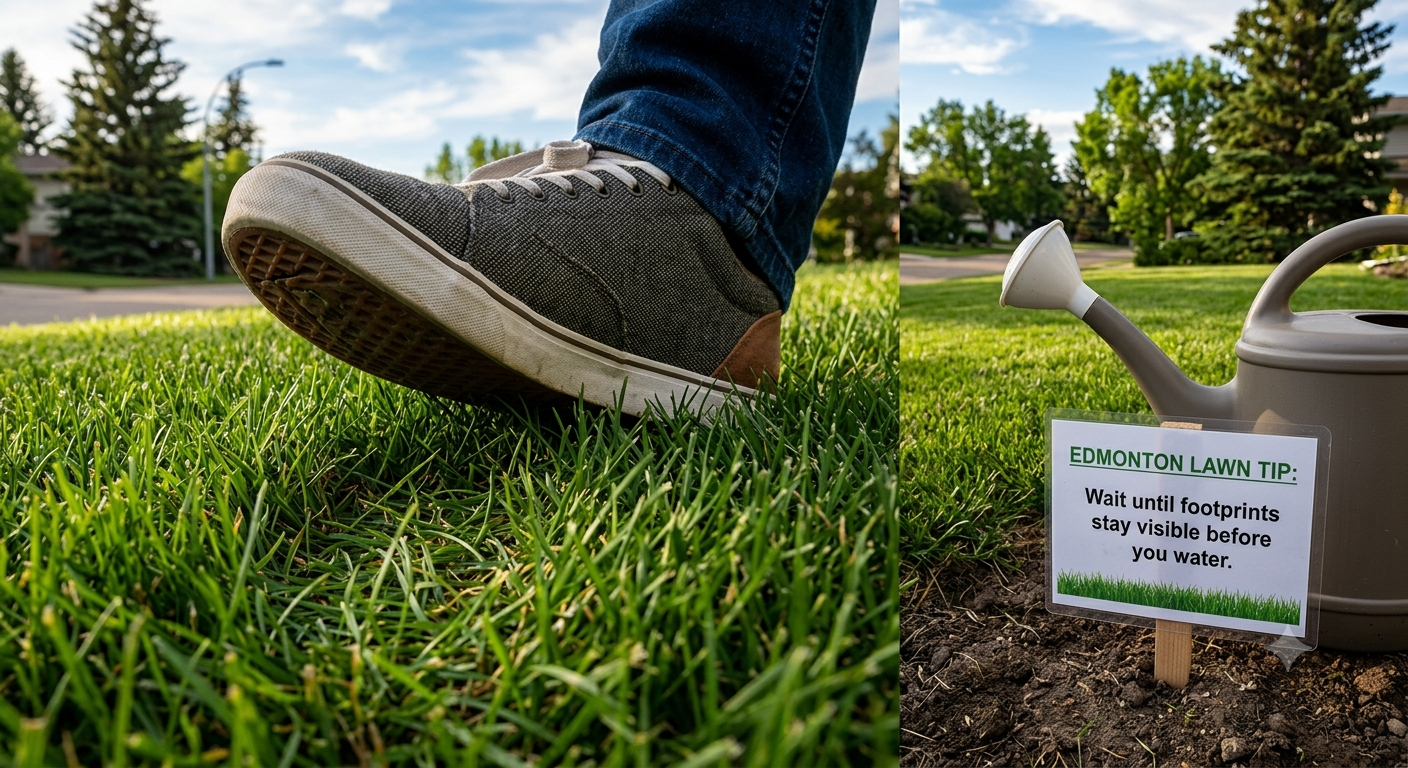
- Footprints that don’t spring back if you walk across the lawn and the blades stay flattened, that’s an early sign of drought stress.
- A dull, blue-grey tint before browning starts often the first visible warning sign.
- Water pooling or running off a sign your soil can’t absorb water fast enough, which usually points to compacted soil rather than a need for more watering.
- Soft, spongy patches often a sign of overwatering rather than underwatering, especially in low-lying areas of the yard.
If you’re seeing thin or patchy grass even with consistent watering, the issue is sometimes not water at all it can come down to soil quality or nutrients, which is worth ruling out before you adjust your sprinkler schedule any further.
What About Different Soil Types?
Not every yard in Edmonton holds water the same way. Sandy soil drains fast and may need slightly more frequent watering, while clay-heavy soil common in older Edmonton neighbourhoods holds moisture longer but can develop runoff if you water too quickly. A simple way to check: push a screwdriver into your lawn a day after watering. If it slides in easily to about 6 inches, your watering depth is on track.
The Bottom Line
For most Edmonton lawns, the sweet spot is 2 to 3 deep watering sessions per week, adjusted up slightly during hot, dry stretches in July and August, and scaled back or skipped during cooler, wetter periods in spring and fall. Watering deeply, early in the day, and paying attention to what your lawn is actually telling you will do far more for its health than watering on autopilot every evening.
If your lawn is still struggling despite a solid watering routine, it might be less about water and more about soil health, mowing height, or fertilization timing all things that work together, not in isolation.
Not sure if your lawn’s issue is watering, soil, or something else entirely? Season Edge has been helping Edmonton homeowners keep their lawns healthy through every season, from spring cleanups to summer maintenance. Get in touch with our team for a quick assessment of your yard we’ll help you figure out exactly what it needs.